The best Practice is the one you will actually do.
Category: Tai Chi
-
Prana and Qi
How do Chakras relate to DanTian? Do TaiChi movements help balance the Chakras?
Strictly speaking, these ideas are built upon completely different systems of energetic anatomy.
They can be regarded as similar (to the extent that they are) but they are equally distinct.Chakra is a Sanskrit term, commonly translated as “Wheel”, and in the tradition of Ayurveda is used to describe spinning wheels of Prana (the Ayurvedic term for Vital-Energy).
The seven primary Chakras are located along the spine, and more or less correspond to various nerve-plexes or glandular-organs in the body.DanTian is a Chinese term, sometimes translated as “Elixir Field”, and in the context of Traditional Chinese Medicine is usually a reference to three “storehouses” of Qi (The TCM term for Vital-Energy), or The “Three Treasures”.
The lower DanTian holds Jing, the original essence of the body.
The middle DanTian holds Qi, the energy available through breath and food.
The upper DanTian holds Shen, the spiritual power and wisdom.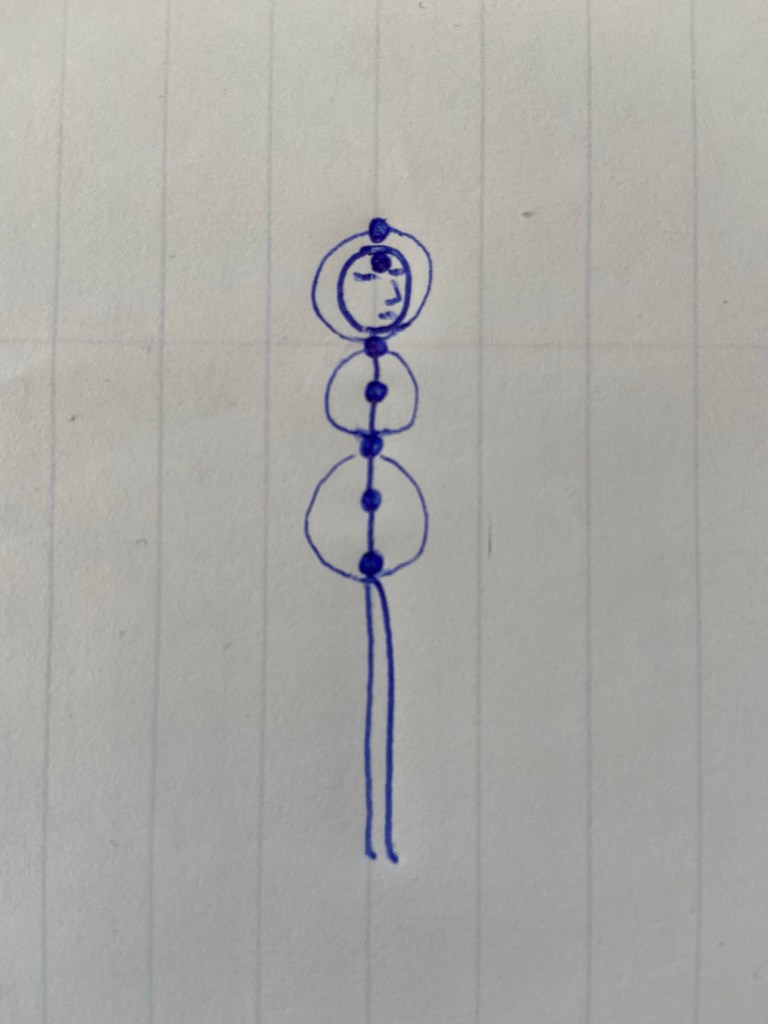
This is not an accurate depiction of the Chakras and DanTians, but rather just a rough illustration of how the differing energetic anatomies relate.
The lower DanTian is “located” similarly to the second (Sacral) Chakra, but also accounts for many of the qualities associated with the first (Root) Chakra and third (Solar Plexus) Chakra.
The middle DanTian is similarly located to the fourth (Heart) Chakra, but also shares characteristics with the third and fifth Chakra.
The upper DanTian is essentially located at the sixth (Third Eye) Chakra, but shares qualities with the fifth and seventh (Crown) Chakras.One key thing these systems do share is a relational-wellness, or holistic dimension.
If any of the primary Chakras is operating in a dysfunctional manner,
it will have an impact on the others as well as the overall health of the Pranic and physical body.
Likewise, if one of the primary DanTian is not in an optimal state, the others will be affected
and the overall functioning of Qi will be compromised.The practice of TaiChi Ch’uan or Qigong is well suited for influencing and interacting with the DanTian and pathways of Qi, known as Meridians.
The many methods and numerous practices which fall under the umbrella of TaiChi were developed with the particular nuance and nature of Qi as a focal point.
The physical practices of Yoga are rooted in Ayurveda, and as such are steeped in the specific perspective of Prana, including Chakras, Marma (Pranic Doorways), and Nadis (Pranic pathways).Practicing Yoga can have an effect on Qi, the DanTians, and the Meridians.
Practicing TaiChi can have an effect on Prana, Marma, and Nadis.Ultimately, it is your intent as the practitioner which will determine the most apparent effects you experience.
If your mind is attuned to a Pranic or Chakra-based perspective, then you will more readily detect the effect of your practice on that system. If your focus is on Qi and the Meridians, you will be more likely to notice the effect your practice has on them.
The distinct energetic anatomies of both Ayurveda and TCM are operative in the human body.
Though the energy systems are equally accessible with various practices, the traditions of each have been built with their particular energy-framework in mind. -
Longitudinal Epiphany

The value of Longitudinal Epiphanies (“discoveries that can only be made by walking the same path again and again”) is blatantly acknowledged by many of the Philosophies of Mind/Body.
Repetitiousness is boring to most people because the brain craves novel experiences. Others find repetitiousness comforting; the predictability of anything is a relief given the apparent chaos of the world.
Leaning to either tendency is perhaps natural, though in a sense less than ideal. To be trapped in the perceived-misery of perceived-monotony and to be caught in the desperate drive to escape them is a similar dilemma.
It has been said that the distinction between a Routine and a Ritual is that, while Routine tends to stagnate or drain Energy, Ritual builds and cultivates Energy.
The line between these can be blurry, no doubt.
But if we can transcend the privilege of our petty boredom, if we can embrace repetitiousness, we may realize that the novelty we seek has been waiting right where we left it. When we are less obsessed with the repetitiveness of an action or routine, and pay attention to the inner-experience we are having, we can discover a rich and perpetually novel circumstance which is inherently refreshed with every iteration.
You cannot enter the same river twice. You cannot repeat a breath. And only by breathing constantly, by stepping into the river repeatedly, can you truly experience how much change is incessantly unfolding.
-
Simple and Practical
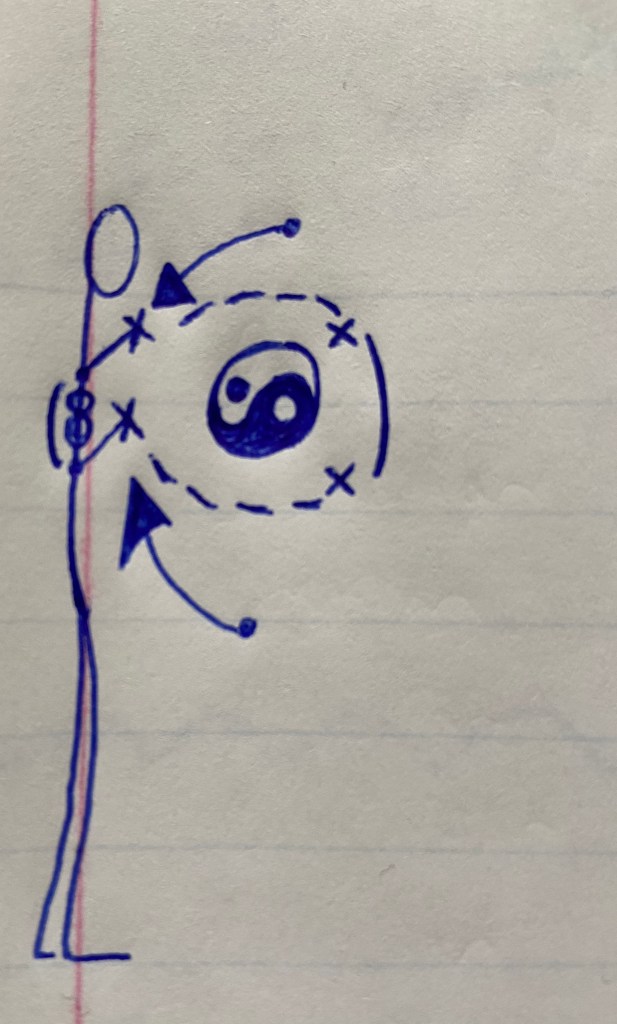
The “Practical Method” of Chen-style Taijiquan developed by Hong Junsheng brings the TaiChi principle into spectacular clarity.
While the forms are given evocative and compelling names such as “White Crane Flashes Wings” and “Part the Wild Horse’s Mane”, the actions which are necessary to perform them are quite simple.
The actions of the upper-body can be reduced to, essentially, two forms. Following the general arc of a circle, the arms are either travelling one way or the other! The Practical Method refers to these as the “Positive Circle” and the “Negative Circle”.
Circular actions of the arm imply motion on both the plane of In/Out as well as the plane of Up/Down. Combined with rotation of the central axis of the body and proper action of the lower-body, these two circular paths account for the entire lexicon of arm actions across all the forms of Taijiquan.
More specifically, the Practical Method asserts that inward action is performed by the elbow (represented by the dots in the illustration above). The elbow is either travelling toward the body from a high, or a low, position. Once the elbow arrives at the body the waist turns (signified by the figure-eight shape) and sets a trajectory for the continued motion of the arm, either on its current course around the circle or reversing course to retrace the circle on which the elbow arrived. Lastly, the hand (shown as an X above) is delievered outward along the circular path in accordance with the trajectory set by the turning of the waist.
The two arms, moving in various combinations along the circular paths described by the Practical Method, need not attend to anything else. The names of postures are merely shorthand and fanciful expressions of very simple directions.
-
Section 2- Sun-style TaiChi 41 Forms: Brush Knee, Play Lute, Deflect Downward, Parry and Punch
Note the funky Follow-Step at :11 and how the foot is drawn inward to the center of the body, rather than maintaining its own lane. The following Cross-Step action is designed to be close to the center-line, but the Follow-Step is intended to be deliberately spaced from the center-line. Even if the Follow-Step and posture is compact, maintaining a “channel” between the Left and Right is generally the rule. Open and Close:
Brush Knee:
Play the Lute:
Deflect Downward:
Parry and Punch:
Embrace the Tiger:
Return to Mountain:
-
Ch’uan
The movement principles of TaiChi, and their expression in the field of Taijiquan (Tai Chi Ch’uan), are far less mysterious than they seem.
For a variety of reasons, Truth can be hard to come by. The biggest impediment, however, is almost always our own refusal to see what is actually quite obvious.
In many cases, a good Teacher will assist us in discovering how to see what we do not see intuitively. In some cases, a good Teacher must further obscure what we do not see intuitively. Yet, in both cases, the task of learning is ultimately up to the student.
The curriculum of Taijiquan has been adapted and even watered-down as it has spread across the globe. As noted above, in some cases this alteration has been intentional and perhaps has been functional or even necessary.
However, as the modified traditions are passed down and further modified with each iteration, the Truth and fullness of the curriculum becomes harder and harder to revive.
While Taijiquan has been adapted to increase accessibility and has helped a massive amount of individuals with countless physical and mental health challenges, there is rarely more than procedural lip-service to the definitively Martial origins and underpinnings of the exercises.
It is undeniably true that Taijiquan is a system of Qigong and has powerful health benefits. It is equally true that Taijiquan is a system of Martial Arts, and the movements and methods of Taijiquan have practical application in combative or self-defense scenarios.
While the reality of this Martial connection is unnerving to some, the underlying principles which make Taijiquan effective for Martial purposes are equally applicable to most (indeed, possibly all) athletic Human endeavors.
The generation, control, and transmission of Power might be the ultimate skill of Taijiquan, which is a useful ability in general. For baseball players, construction workers, and even a little old lady, the ability to mindfully use Power is worth cultivating.
The skill needn’t be Martial in application, but there is no better platform for observing the movement principles of Taijiquan than in the context of Martial Arts. The “Ch’uan (Quan)” in TaichiCh’uan/Taijiquan means “fist” or “boxing” and to see Martial movements is to see the principles of TaiChi in action.
Below you will observe blatantly Martial movements, but if you look beyond the merely Martial you will see the principles of Follow-Step (from Sun-style Taijiquan), Rooting, Zhan Zhuang Posture, etc.
The principles are present, whether the action is obviously Martial or not. Learn to see the principles everywhere and you can begin to use them anywhere.
The video-filter has conveniently generated vertical lines highlighing the deliberate vertical energy of Taijiquan. The Follow-Step principle is naturally and necessarily present throughout, both as a striking technique and as a space-management tactic, respectively. -
The TaiChi of Suffering
To not get what you want is Suffering.
To get what you don’t want is Suffering.
To get what you do want is also Suffering because everything is ultimately consumed by the churning of Time, and what we want to get, even if we do get it, is eventually lost.
Yin and Yang make measure of each other.
Yin and Yang follow one another.
Any Thing, Experience, Phenomenon is neither Good nor Bad inherently except to the extent that you realize it is precisely as Good as it is Bad.
It Is Both.
It Is Neither.
It Is.
Tao.
-
A Poem about a Path
The Path to Mastery may be Winding.
The Mystery has a History of being fleeting.
Stand Still to travel Far.
The Stars are already Moving.
Motion; there is an Ocean inside You.
You.
Your Vibration.
Contemplate that Sensation.
See any and all Horizons winding.
Rotation, around a Stationary Location.
An Origin.
If only in This Moment.
Here.
Now. -
We is Me
In Today’s class, we reflected on whether TaiChi is meant to be a solo endeavor, or intended to be a group exercise.
True to the wisdom of TaiChi, the answer is both!
The dynamic of a group depends upon the dynamics of each individual.
A thriving group experience requires the individuals to each bring the best of their skills and knowledge to the collective.
When an orchestra prepares for the big performance, each player spends hours dedicating themselves to their individual task. The entire orchestra doesn’t convene, and nor should it, just because the 5th violin player is struggling with a meticulous passage.
The solitary efforts of the 5th violinist are the ground for breakthroughs which can be made worthwhile when the larger whole comes together. The individual can devote their solo-practice time to whatever they need without hindering the group, yet without the group’s effort, the individual effort may not have a platform for expression or application.
The lone violinist cannot truly play the symphony as an individual, and the orchestra cannot truly play the symphony if any individual is blundering.
The strength of the whole is dependent on the strength of the individuals.
TaiChi, as a Practice, is an opportunity to refine ourselves as individuals so that when we enter into collectives we inherently make them better. The greatest service we can do for the whole is to be a whole-individual. When the whole is optimal and healthy, it can accommodate many individuals.
When practicing solo, it is both for your personal benefit and the benefit of others. You cannot share what you don’t understand nor contribute what you do not have.
When practicing in a group, it is for the benefit of the group and for your own personal benefit. You can bring your enthusiasm and energy, but managing the needs and preferences of Others is an exercise which cannot occur in isolation.
The TaiChi Principle is most blatantly manifest as Self/Other. Without Others, or a collective, our understanding of “Self” or “me” is incomplete. Without a sound sense of “Self”, “me”, or “I”, then we cannot meaningfully relate to a group or a whole.
For TaiChi Practice to be complete, we will invariably need to experience and explore both the social and solitary conditions of our Humanity.
-
The Practice: A Poem
WUJI: NO-Polarity
To Know Taiji, one must practice Wuji…
Be Still and Quiet…
Observe EVERYTHING happening around you…
Now shift ALL of that focus to just yourSelf…Notice any undue Effort or Tension…give it to Gravity instead…
Notice your BReath…Notice your Breath…Notice the Motion…
Notice the RHYTHM…
Notice the Pace…
Relax and just let it happen
This Is;
The Practice
 Yin-Yang-Yoga