Category: Thoughts

  • Maximum Yin is Already Spring

    I’ve said it elsewhere before, but I continue to be intrigued by the approach, arrival, and departure of the Winter Solstice as a period of maximum Yin (as far as daylight goes, anyhow). Meanwhile, in terms of temperature, the shortest day of the year is rarely the coldest day of the year. Light moves faster than the air, I suppose. It is interesting that there is an offset of these Wintry experiences of Yin (from the Northern Hemisphere).

    While the shortest burst of daylight is reliably around December, 21st, the coldest temperatures often come flowing in during the weeks after the return to longer periods of daylight is well underway. Mid-January is a much more likely candidate for coldest stretch of the year, and often carries much more snowfall too. For the photo-sensitive, the depth of Winter is technically quite brief. For the temperature-sensitive, the depth of Winter is an enduring plateau. This thermal lag can make the Winter seem more dramatic than it truly is.

    If you follow the light, the coldest days are truly but the beginning of the Spring.

  • Full Moon in Aquarius

    Today is the Full Moon in Aquarius.

    Freedom and Humanitarianism are thematic staples of the sign of Aquarius.

    But what does that really mean?

    Aquarius, in some ways, represents the Individual’s Last Stand. While Leo signifies the Individual as such, Aquarius shows us the Individual related to others. Aquarius natives often carry a reputation for Humanitarian impulses, but to be a Humanitarian is to be an Individual invested in Humanity as a whole.

    Aquarius is the natural 11th House, where groups of Humans may gather as communities and societies. However, the key feature at this level of coming together is that the Individual is still vital. A chain breaks at its weakest link, no matter the strength of the rest. At the scale of the 11th House, it is still meaningful to address specific persons in the system.

    In the 12th House, the domain of Pisces, the Individual is no longer relevant. The 12th House is absorptive and subsumes the Individual. Systems which supersede individuality are 12th House phenomena- the prison, the monastery, the military. Individuals may choose to enlist or be committed against their personal will, but regardless, once there, will lack the capacity to meaningfully impact the structure. Droplets in the vast ocean can have their distinct experience, but they cannot direct the tides.

    Locally, this Full Moon lunation presents with the Sun nearly exact on the MC with the Moon nearly exact on the IC.

    What you encounter is often a precise reflection of what you’re seeding.

    The Sun in Leo is indicative of our Individual power, shining bright. Its placement on the MC (Midheaven) suggests that full embodiment and responsibility for that light and power is our highest possible calling and aim.

    The Moon in Aquarius suggests the impact of that light in our social surroundings. The Moon on the IC (Imum Coeli), our psychological (and often literal) figure ground, may give us the strong sense that the actions of others are affecting our own efforts and objectives. With all of its humanitarian potential, Aquarian energy can readily polarize into misanthropy.

    For some, this Full Moon may pose a pop-quiz regarding faith in their own power.

    Believing that our personal objectives are being stifled, it is easy to resort to blaming others. Yet this lunation is an opportunity to consider that what we encounter is likely to be a precise reflection of what we are seeding, consciously or otherwise. If you’re not getting the results you want, reflect on the totality of that which your efforts are being built upon.

    The Sun is shining down from the (relative) place of absolute Above. The Moon is reflecting from the (relative) place of absolute Below. This is a potent opportunity to acknowledge any dissonance between our highest calling and our lowest intent.

    What are your loftiest aims?

    What are your deepest philosophical assumptions?

    You cannot meaningfully invest in World Peace if you don’t actually believe it can be achieved. You cannot meaningfully combat Climate Change if you don’t believe it’s possible to affect it.

    If you do believe your aims are possible, then it’s a waste of your energy to rail against and bemoan the challenge.

    YOU have picked this struggle.

    If you discover that you don’t actually believe the goal can be accomplished, then take a load off. If you sincerely believe it is a worthy battle, then don’t undermine your efforts with petty self-righteousness.

    This Full Moon is a profound opportunity to refine our personal power.

    Call into coherence your power and purpose.

    If it feels as though the people surrounding you are dimming your cause, shine brighter. If you believe your light is not sufficiently bright, dare to enter the cavernous dark.

    If you accomplish nothing else in this lifetime, have the courage to discover and disseminate your most authentic self. Have the courage to face your most authentic self.

    Be brave enough to shine in the dark.

    Be brave enough to receive and reflect any light which may be burning brighter than yours.
  • Polarity Is Not Plural

    Tai Chi, or Tai Ji, when literally translated renders as something like:
    Grand Polarity, Supreme Extreme, Ultimate End.

    This is significant because the translation, and therefore the original (we should hope), is singular.
    To speak of many, or even merely multiple, Tai Ji is a logical error. Beyond the colloquial uses of Tai Chi, its core definition refers to THE fundamental polarity which pervades our reality.


    Every known expression of polarity- Hot & Cold, Up & Down, Inside & Outside- is built upon the same principle. With this in mind, it is more apparent that there is a flaw of logic when speaking about polarity in the plural. We can discuss specific manifestations of this single principle, but no quantity of these can fracture the underlying phenomenon which they are all an expression of.

    This is the insight which the ancients were attempting to disclose to us.

    The Grand Polarity is the structural fact of polarity which gives rise to experiences of polarization. The phenomenon of polarity itself is the only thing which can be properly described as Grand Polarity. The phenomenon of polarized extremes is always more fundamental than any set of such extremes. There is an underlying principle, a unifying theme, to be found in all cases of extremes and opposites.

    To be diametrically-opposed is to be inextricably-linked.

    The revelation of Tai Ji is a key to peek through the illusory nature of all expressions of opposites.
    Once this key has been turned, the polarized conception of the world becomes erroneous, though still applicable. We can speak the language of Up & Down, Hot & Cold, etc. without being misled by it. We are aware that Hot & Cold are both Temperature; that Up & Down are both Direction. We do not lose our picture of ordinary reality, we merely glimpse and remember its substrate. Knowing the structure of our experiences allows immense sobriety while we play with these experiences.


    To play with the experiences, rather than being played-by the experiences, is a step toward the profound liberation which all spiritual paths proclaim to be possible.

  • Your Suffering is the Least Interesting Thing About You

    Suffering is a Given.
    What are you doing with it?
    That is the issue at hand.

    At the first-principles scale, Suffering is non-specific and indistinguishable.
    There are no prizes for “Most Traumatized” or “Worst Case Scenario”.
    I like to describe this as the “Function” level of Suffering.
    Its complement, the “Content” level, is where we get to play and chew on individuality and distinctions.
    The Content of Suffering may look like:
    My husband of 30 years just disclosed 32 years of infidelity.
    A lung cancer diagnosis.
    Being harassed by police because of racial biases.
    Going to bed hungry.
    Falling down and scraping your knee.
    Your ice-cream falling off the cone and plopping onto the sidewalk.

    If you find yourself in the throes of your discriminating mind and wonder if it’s even loosely appropriate to lump these together on the same list, I might (in a more audacious moment) propose that perhaps you have so drastically distanced yourself from your own emotions or memories that you fail to remember as a child you surely sobbed and wailed for all of Humanity when you forgot to hold on to your balloon and it floated away. You may not be able, or you may be consciously choosing to refuse, to remember how you moaned and shrieked and rolled about on the floor while pounding your fists because it’s time to leave the house, or to return to the house. You may not remember your own chaotic boiling associated with simply being told it’s time to brush your teeth and get in your bed. But you will assuredly feel it again someday, consciously, and with achingly profound and undeniable awareness.

    As children, the Content of Suffering is effectively irrelevant. Perceptual experience is so fresh and raw that nearly every single phenomenon that pings us at all feels like either a revelation of ecstasy and joy, or a personalized catastrophe of greeting cards from Hell. With the passing of time and the accrual of more and more experience, we typically find that we become less reactionary to some of the common Sufferings of being Human. Bedtime, whether tragically or miraculously, comes day after day. We discover that we will leave home, and return to it, many times (barring drastic cases of agoraphobia and similar circumstances) for both exciting and mundane reasons. In this manner, we gradually lose touch with the realization that Suffering is so utterly rampant. Call it “developing tolerance” or chalk it up to some form of desensitization, growing thicker skin, getting used to it. In any case, after constant exposure to the many permutations of Suffering available to us, in time it takes ever more grandiose forms of Content to rekindle that raw and unrestrained recognition of Human Suffering. See the items at the top of our short list of potential devastation.

    All of this is just to suggest that there is nothing impressive or laudable, nothing uniquely tragic or important, about your experience of Suffering. No matter how extreme the degree, or extensive the breadth of the Content, the Function level of your Suffering reduces to “On” or “Off” (and, of course, from a Buddhist perspective it is definitively always on). While it is valuable to acknowledge the specifics of that which we individually suffer at the level of Content, it is a decidedly predictable and brief game to play unless we’re utterly dedicated to our misery.

    At the risk of sounding harsh, the only response I can authentically offer to someone who might risk the vulnerability of sharing their tale of Suffering is this: So what?
    So. What.
    ?
    What now?
    What for?
    What do you want me to do, then?
    What do you need?

    The fact of our Suffering is not interesting, it’s obvious and built-in to the Human experience.
    The Content of our Suffering is, at best, vaguely compelling as flavoring and insofar as it stokes the Egoic flames of ownership and possession.
    That flavoring is really just an indication that something is there.
    The Content is proof of the Function.

    So, you’re suffering.
    So is everyone who exists, will exist, and has existed.
    That’s not a statement of deflection or dismissal, and literally not one of denial, despite how it often is perceived.
    So you’re suffering.
    So What?
    So what are you doing with your Suffering?
    So what are you doing about the fact of Suffering?
    How does it make you move?
    How does it dare you to laugh?
    How does it allow you to cry?
    How does it demand that you heal?

    Everyone has the Suffering.
    It is the manner in which we relate with it that affords us an opportunity to be uniquely interesting.
    The Art of Life is the way we confront, embrace, and transmute the fact of Suffering.

    When the Suffering demands that we discover a Joy and Peace far more pervasive than it in order to continue to exist, we can trust that we have truly begun to live. When we do discover our greater Joy, our more profound Peace, then we begin to see Suffering as it actually is. We no longer enshrine the details of our misery, though we certainly still could. When we begin to appreciate Suffering at the level of Function it loses some of its luster and sharpness, yet it grows in its quantity and magnitude. The focus is no longer “MY” Suffering but becomes “THE” Suffering, of which there is undeniably no shortage. The crystal clarity and keen focus of “my” precious Suffering gives way to the dull and pervasive thrum of “the” Suffering across time, and spanning generations. It is undeniably present, but in essence it’s merely a blank canvas. Our particular instance of Life, this specific and distinct experience of being alive, is an opportunity to paint. Let Suffering compel you toward something Joyful, toward genuine Peace. Not merely running from Suffering, but a Joy and Peace so profound that you find yourself utterly willing, and maybe even authentically receptive to walking through the Suffering.

    Your Suffering is the least interesting thing about you.
    Tell me about your Joy.
    Tell me about your Passion.
    Suffering is not unique.
    It is a dull throb undergirding our entire existence.
    What have you found which is more compelling than that boring ache?
    If you have yet to discover your answer,
    then you cannot afford to worship at the Idol of your Suffering one single breath longer.

  • TaiChi Encourages Epistemic Humility

    What do You see?
    What does He see?
    What do We know?

    TaiChi as a principle implies polarity across all dimensions.

    There is always, it would seem, a plane or a point you cannot see.

    If your attenion is focalized anywhere, something will be obscured from you.

  • Which Practice is the Best?

    The best Practice is the one you will actually do.

  • Prana and Qi

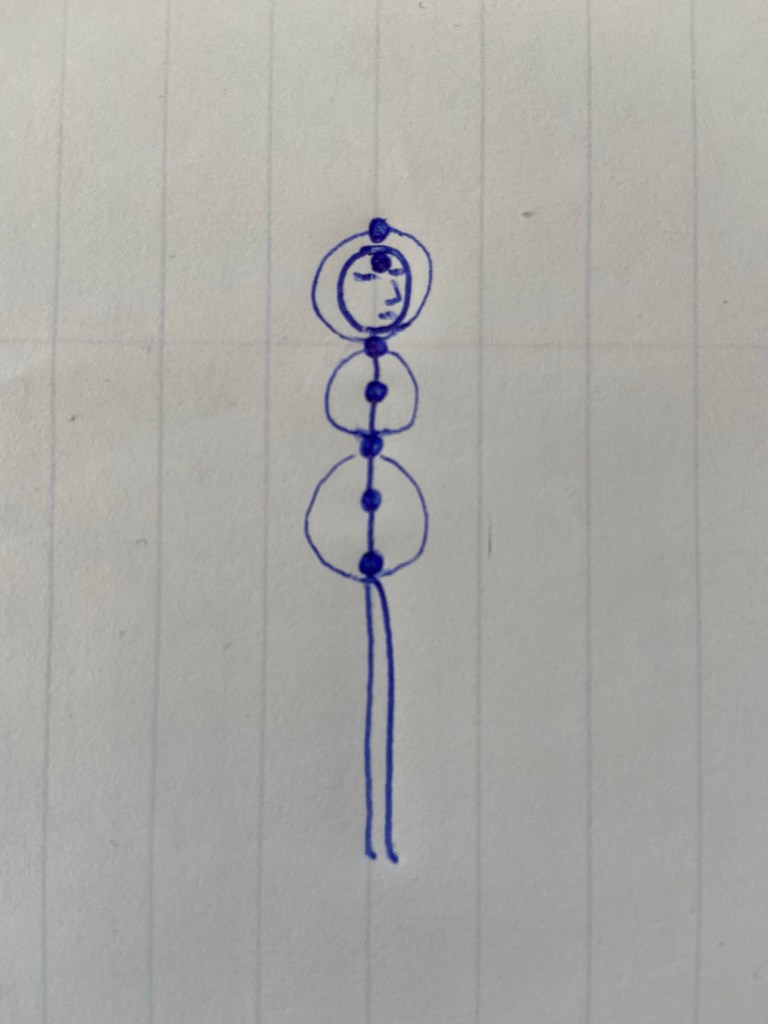
    How do Chakras relate to DanTian? Do TaiChi movements help balance the Chakras?

    Strictly speaking, these ideas are built upon completely different systems of energetic anatomy.
    They can be regarded as similar (to the extent that they are) but they are equally distinct.

    Chakra is a Sanskrit term, commonly translated as “Wheel”, and in the tradition of Ayurveda is used to describe spinning wheels of Prana (the Ayurvedic term for Vital-Energy).
    The seven primary Chakras are located along the spine, and more or less correspond to various nerve-plexes or glandular-organs in the body.

    DanTian is a Chinese term, sometimes translated as “Elixir Field”, and in the context of Traditional Chinese Medicine is usually a reference to three “storehouses” of Qi (The TCM term for Vital-Energy), or The “Three Treasures”.
    The lower DanTian holds Jing, the original essence of the body.
    The middle DanTian holds Qi, the energy available through breath and food.
    The upper DanTian holds Shen, the spiritual power and wisdom.

    This is not an accurate depiction of the Chakras and DanTians, but rather just a rough illustration of how the differing energetic anatomies relate.
    The lower DanTian is “located” similarly to the second (Sacral) Chakra, but also accounts for many of the qualities associated with the first (Root) Chakra and third (Solar Plexus) Chakra.
    The middle DanTian is similarly located to the fourth (Heart) Chakra, but also shares characteristics with the third and fifth Chakra.
    The upper DanTian is essentially located at the sixth (Third Eye) Chakra, but shares qualities with the fifth and seventh (Crown) Chakras.

    One key thing these systems do share is a relational-wellness, or holistic dimension.
    If any of the primary Chakras is operating in a dysfunctional manner,
    it will have an impact on the others as well as the overall health of the Pranic and physical body.
    Likewise, if one of the primary DanTian is not in an optimal state, the others will be affected
    and the overall functioning of Qi will be compromised.

    The practice of TaiChi Ch’uan or Qigong is well suited for influencing and interacting with the DanTian and pathways of Qi, known as Meridians.
    The many methods and numerous practices which fall under the umbrella of TaiChi were developed with the particular nuance and nature of Qi as a focal point.
    The physical practices of Yoga are rooted in Ayurveda, and as such are steeped in the specific perspective of Prana, including Chakras, Marma (Pranic Doorways), and Nadis (Pranic pathways).

    Practicing Yoga can have an effect on Qi, the DanTians, and the Meridians.
    Practicing TaiChi can have an effect on Prana, Marma, and Nadis.

    Ultimately, it is your intent as the practitioner which will determine the most apparent effects you experience.

    If your mind is attuned to a Pranic or Chakra-based perspective, then you will more readily detect the effect of your practice on that system. If your focus is on Qi and the Meridians, you will be more likely to notice the effect your practice has on them.

    The distinct energetic anatomies of both Ayurveda and TCM are operative in the human body.
    Though the energy systems are equally accessible with various practices, the traditions of each have been built with their particular energy-framework in mind.

  • Longitudinal Epiphany

    The value of Longitudinal Epiphanies (“discoveries that can only be made by walking the same path again and again”) is blatantly acknowledged by many of the Philosophies of Mind/Body.

    Repetitiousness is boring to most people because the brain craves novel experiences. Others find repetitiousness comforting; the predictability of anything is a relief given the apparent chaos of the world.

    Leaning to either tendency is perhaps natural, though in a sense less than ideal. To be trapped in the perceived-misery of perceived-monotony and to be caught in the desperate drive to escape them is a similar dilemma.

    It has been said that the distinction between a Routine and a Ritual is that, while Routine tends to stagnate or drain Energy, Ritual builds and cultivates Energy.

    The line between these can be blurry, no doubt.

    But if we can transcend the privilege of our petty boredom, if we can embrace repetitiousness, we may realize that the novelty we seek has been waiting right where we left it. When we are less obsessed with the repetitiveness of an action or routine, and pay attention to the inner-experience we are having, we can discover a rich and perpetually novel circumstance which is inherently refreshed with every iteration.

    You cannot enter the same river twice. You cannot repeat a breath. And only by breathing constantly, by stepping into the river repeatedly, can you truly experience how much change is incessantly unfolding.

  • The TaiChi of Suffering

    To not get what you want is Suffering.

    To get what you don’t want is Suffering.

    To get what you do want is also Suffering because everything is ultimately consumed by the churning of Time, and what we want to get, even if we do get it, is eventually lost.

    Yin and Yang make measure of each other.

    Yin and Yang follow one another.

    Any Thing, Experience, Phenomenon is neither Good nor Bad inherently except to the extent that you realize it is precisely as Good as it is Bad.

    It Is Both.

    It Is Neither.

    It Is.

    Tao.

  • A Poem about a Path

    The Path to Mastery may be Winding.
    The Mystery has a History of being fleeting.
    Stand Still to travel Far.
    The Stars are already Moving.
    Motion; there is an Ocean inside You.
    You.
    Your Vibration.
    Contemplate that Sensation.
    See any and all Horizons winding.
    Rotation, around a Stationary Location.
    An Origin.
    If only in This Moment.
    Here.
    Now.