Category: Tai Chi

  • The Path of The Circles

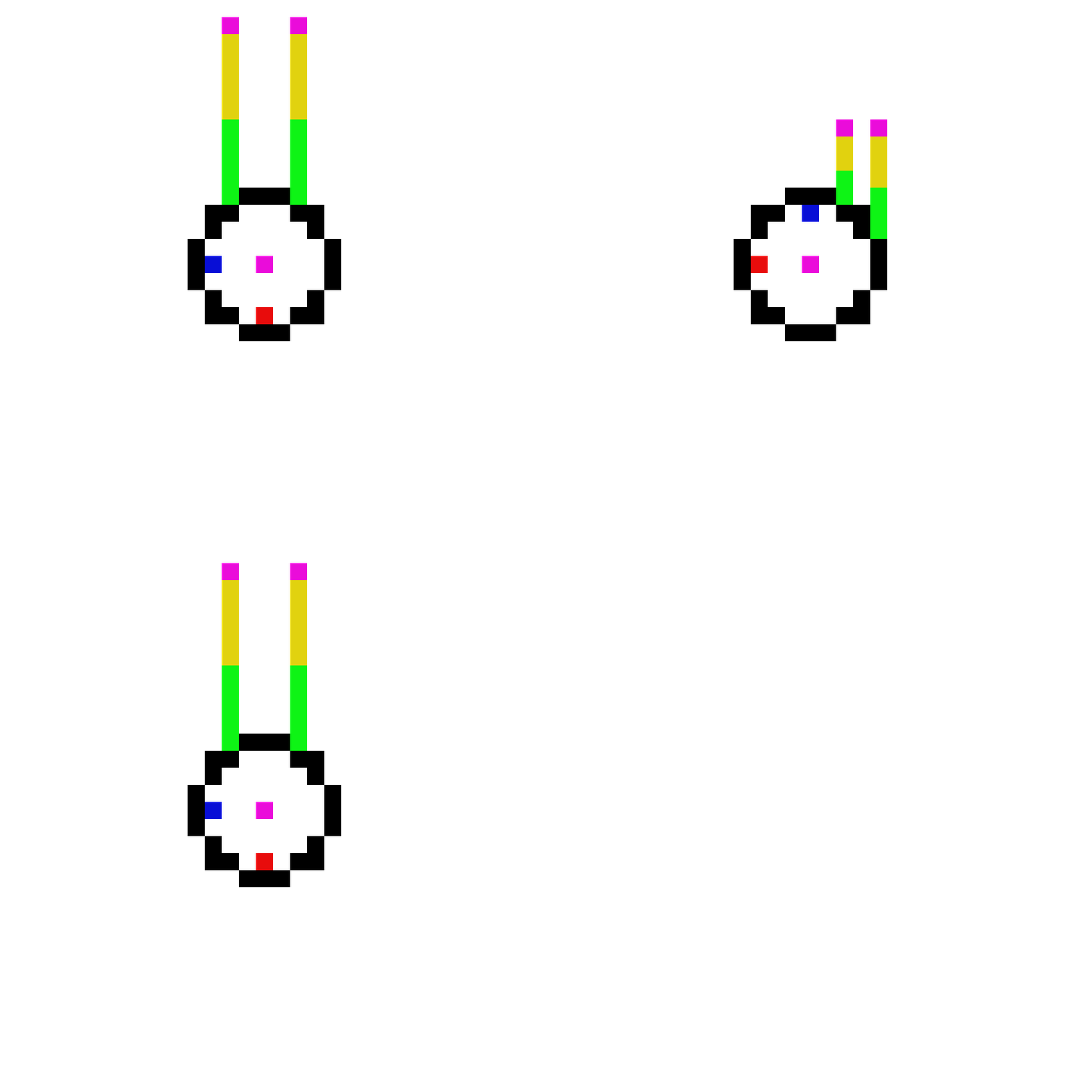
    Here we can see, side by side, the path of the two circles.

    On the left, the Negative Circle is drawing in from the top and contacting the Center above the “Horizon”, as shown with the red dot.

    On the right, the Positive Circle is drawing in from the bottom and contacting the Center below the “Horizon”, as shown with the blue dot.

    Also, we can see an exaggerated expression of the forearm which remains level with, or parallel to, the “Horizon”, as shown with the green line.

    the-circles-1

    Though we sometimes engage with these paths as independent, it is worth remembering that the Energy which ultimately propels them works on a vertical axis. Yin-Energy rises up from the Earth, while Yang-Energy descends from the Sky.

    It may be fair to assert that the Positive Circle is generated with Yin-Energy (thus the blue dot is raising the green line), but reconciles in Yang-Energy (thus the blue dot later exerts downward on the green line).

    Conversely, the Negative Circle is generated with Yang-Energy (thus the red dot presses the green line down), but reconciles in Yin-Energy (thus the red dot eventually lifts the green line upward).

  • Using Rotation to generate Motion and Power

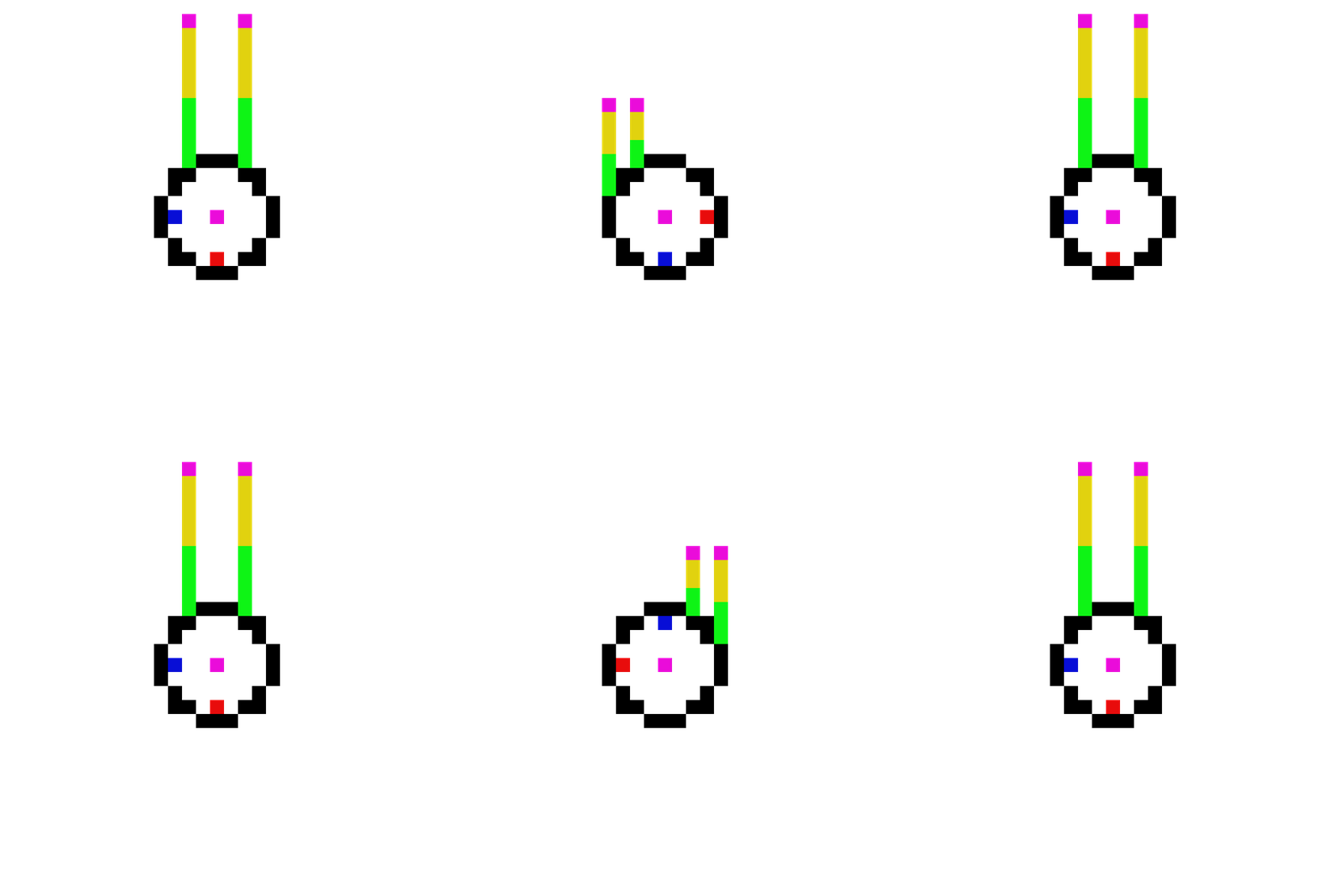
    It might be represented in this manner…

    1) On the left- Rotation alternated in both directions

    2 and 3) On the right- Rotations repeated on the same side in one direction

    The black circle represents our Spine. It rotates, but it does not move (as emphasized by the violet dot- our true “Center”). The Red/Blue dots give us an orientation from which to observe Rotation.

    The Green/Yellow lines, representing the Arms, demonstrate drawing the Elbow in and extending outward through the Hand.

  • Walking to Wuji

    The “Tai Chi Walking” exercise is well-known and widely-practiced.

    A walking meditation…

    It’s worth remembering that

    what we’re really practicing

    is a single Step.

    Many times.

    Returning

    to the steadfast

    wuji.

  • Meditation

    In meeting with several teachers and associates today, the topic of Meditation came up.

    Recently, Meditation has also been mentioned more often on SocialMedia and in other arenas of dialogue. Of course, this includes the voice of non-meditators, some of whom feel a sense of peer-pressure (if not the pressure of pure smugness and superiority) from the pro-Meditation crowd.

    Today’s conversations helped me appreciate the diverse possible approaches to Meditation. Certain systems of Meditation exist with specific instructions and time-tested methods. Some traditions and lineages of Yoga are examples of this, though Modernity has also spurred a large blurring of lines and borders between different traditions.

    In any case, if we were to avoid asking the adherents or advocates of a particular system or brand of Meditation, we would find that Meditation itself can be practiced and applied (or at the very least, conceived of) in many ways.

    There are Buddhist perspectives that suggest manual labor to be among the best of Meditations.

    Many Yoga classes invite us to use Savasana as a Meditation.

    TaiChi CHuan is often marketed as a “moving meditation”.

    These are all active attempts or efforts at Meditation;

    what of the inadvertent or unassuming Meditations?

    Riding a bicycle down a smooth road on a sunny day. Fishing a lazy stream in the late afternoon. Lounging, legs-up, on the sofa as gentle breezes whisper in the branches outside the window.

    Meditation might be more properly thought of as an Experience.

    Any Experience during which we are wholly (or transcendentally, to look at it from the other side of the coin) engaged, fully attuned, whether by way of keen mental-acuity, or that broader body-based proprioceptive perspective, being truly In-The-Moment is the bottom-line of Meditation.

    Surely an exception to the Rule might exist, but I believe Everybody pursues Meditation, whether they realize it or not.

    A Runner’s High. The first bite of a sumptuous meal. A job well-done.

    Meditation, in it’s truest form, is something that happens without our recognition more often than not.

    See if you can catch yourself meditating from time to time. The people who claim to not want anything to do with Meditation might find that they already DO meditate, and perhaps more often than many people who have bumper-stickers declaring their Practice.

    Meditation as a Practice in and of itself is certainly not Everybody’s cup of tea.

    Meditation as a general category of States-of-Being, however, is something inherent to the Human condition. It is simply a part of our Natural Experience.

  • On Progress

    Embarking on a TaiChi or Yoga journey often seems like stepping onto a linear path, but in my own experience this has proven to not be the case.

    Something about the Western Mind, in particular, insists on this sense of linear progression.

    Always forward, upward, onward…

    Lately, it has occurred to me that the more Time I spend on the Journey, the less linear it becomes. To speak in linear terms, there is a lot of backward, downward, sideways, and cyclical.

    We tend to like Asana practice and Forms practice because they give us the tangible and concrete sense of improvement, achievement, and progress that makes sense to the Mind.

    Although growth in these aspects has plenty of value, it is simply incomplete, if we are truly engaging with Yoga or TaiChi. We might accomplish a great amount, but it isn’t whole.

    If our Practice were about Color, progressing in Asana or Forms would be like trying to get really good at Red; we could be the Reddest Red around, but we have been offered an entire rainbow!

    This is not to suggest that practicing only the physical aspects of Yoga or TaiChi is bad. Progress in these areas is absolutely valid and measurable, which is precisely why it is, in fact, good. To leave Asana or Forms training out of the picture would be equally problematic.

    But it’s easy to get lost in that linear-mindset. Our Type-A neuroses, our pathological Desire can easily creep in and undermine the Internal work which occurs often just outside of our field of awareness.

    It has been my impression lately that the expansion of that awareness is a more useful measure of progress. The longer we keep at it, and the deeper our Practice becomes, the more we realize how much mountain there actually is to climb and how deep the Rabbit-Hole really goes.

    Our perspective begins to take in more and more of the picture, and we zoom out rather than zoom in. It’s not about climbing the mountain at all. Just look at it!

    Linear progress suggests that we get to leave behind, or graduate from what we’ve learned. Progress in Practice is expansive. We don’t leave anything behind. We assimilate the old and the new simultaneously, perpetually, and wholly, and they always inform each other.

    We come to know the “basics” in an intimate manner as we are able to apply them across a broader and ever-broadening spectrum. Progress spreads outward, and we can grow in our Practice because we are always still embracing step-one.

    Find the Center, keep the Center. The TrueSelf resides there!

  • If You’re Bored, You’re Boring

    One of the best things about both Tai Chi and Yoga is that no matter how long you Practice, no matter how skillful you are with the postures or movements or principles, you never truly outgrow the Basics.

    This is precisely what attracted me to these disciplines.

    There is no Finish Line.

    My Tai Chi practice as of late has been simplified to just the first few moves of the Sun 41 set. The more attention we pay to the Internal aspects, the less need we find for dozens of postures.

    This is not a knock on things like Sirsasana (Headstand) or lightly flowing through a Tai Chi set.

    The same attention to detail, the mindfulness and Presence, can be exercised in these ways too. It’s just that our achievement-oriented Minds often believe that progress is only measured by accomplishing a more difficult posture or learning the next sequence of forms.

    I am fond of suggesting that if you’re bored, then you’re boring.

    If you’ve run out of things to discover in Tadasana or the commencement form in Tai Chi, then you’ve probably actually stopped paying enough attention.

    I’m not sure if it’s Restlessness or Entitlement-Culture, but many of us, myself included, are so busy striving and believing that we are ready for The Next Big Thing that we miss the Beauty of more simple achievements.

  • Tai Chi on TV

    Tai Chi occasionally makes an appearance in advertising…

    But don’t be like Regular Rob Lowe. His Tai Chi is pretty mediocre.

    Can you spot the things Mr. Lowe needs to work on?

  • TaiChi Is A Little Spooky

    It has been said that before Knowledge there was Truth.

    It would seem that some of the wisdom expounded in the Tao Te Ching might exemplify this notion.

    One of the peculiarities discovered by physicists only about a century ago, is the phenomenon known as Entanglement.

    The laws of Quantum Mechanics seem to suggest that particles can be linked in pairs (or groups) in such a way that the state of one inherently implies the opposite state in the other.

    Consider a pair of electrons.

    Upon measurement, an electron particle is found to have a clockwise spin. That measurement, the determination that Particle A has a clockwise spin, allows us to predict, correctly, that Particle B will have a counter-clockwise spin.

    It’s as if the particles are able to communicate, or interact, almost instantaneously, even across great distances. Albert Einstein himself, who was rather perturbed by the idea that particles could have this apparent ability to affect one another, described it as “Spooky Action at a Distance.”

    This phenomenon has sparked much discussion, debate, and experimentation that is still ongoing to this day. Modern Science is trying to make sense of what seems to be physical proof of a notion seemingly understood thousands of years ago.

    Out of the Void (Wuji), we arrive at polarity, or Taiji (TaiChi). Where there is Yin, we can be assured of Yang. To find one is to imply the other.

    Modern Science has allowed us to demonstrate, observe, and verify, down to the smallest scales imaginable, that this notion of TaiChi is in play.

    What the Ancients understood as being The Way, Science is grappling with Today.

    Our Knowledge is catching up to Truth!