The best Practice is the one you will actually do.
Category: Yoga
-
Prana and Qi
How do Chakras relate to DanTian? Do TaiChi movements help balance the Chakras?
Strictly speaking, these ideas are built upon completely different systems of energetic anatomy.
They can be regarded as similar (to the extent that they are) but they are equally distinct.Chakra is a Sanskrit term, commonly translated as “Wheel”, and in the tradition of Ayurveda is used to describe spinning wheels of Prana (the Ayurvedic term for Vital-Energy).
The seven primary Chakras are located along the spine, and more or less correspond to various nerve-plexes or glandular-organs in the body.DanTian is a Chinese term, sometimes translated as “Elixir Field”, and in the context of Traditional Chinese Medicine is usually a reference to three “storehouses” of Qi (The TCM term for Vital-Energy), or The “Three Treasures”.
The lower DanTian holds Jing, the original essence of the body.
The middle DanTian holds Qi, the energy available through breath and food.
The upper DanTian holds Shen, the spiritual power and wisdom.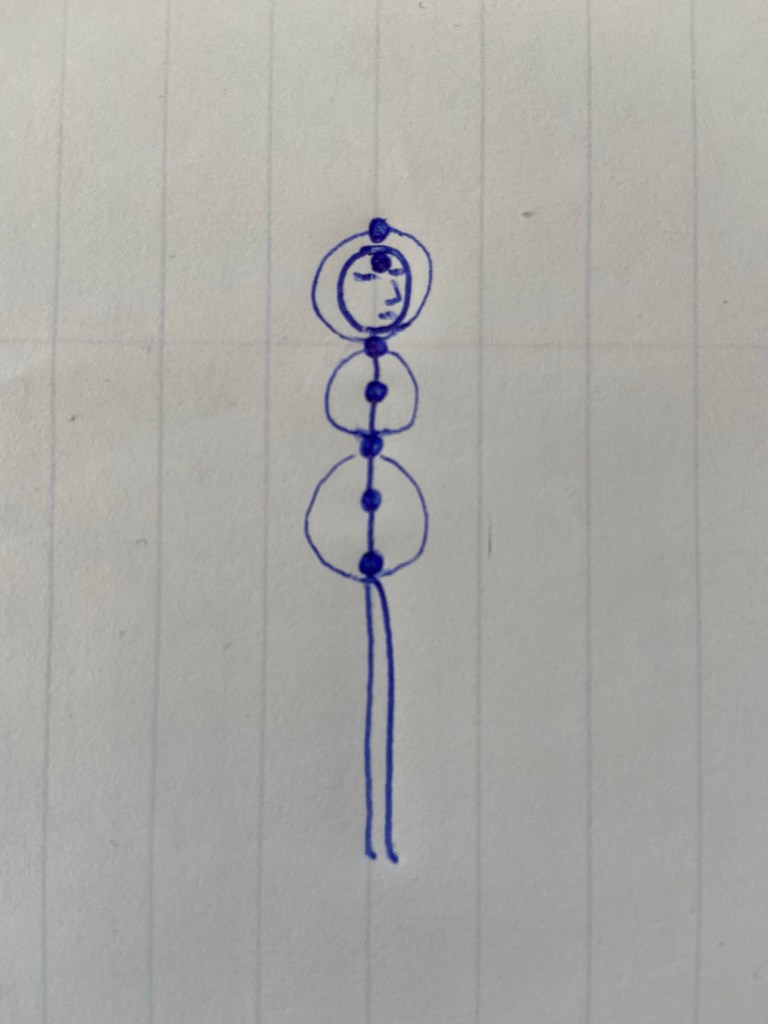
This is not an accurate depiction of the Chakras and DanTians, but rather just a rough illustration of how the differing energetic anatomies relate.
The lower DanTian is “located” similarly to the second (Sacral) Chakra, but also accounts for many of the qualities associated with the first (Root) Chakra and third (Solar Plexus) Chakra.
The middle DanTian is similarly located to the fourth (Heart) Chakra, but also shares characteristics with the third and fifth Chakra.
The upper DanTian is essentially located at the sixth (Third Eye) Chakra, but shares qualities with the fifth and seventh (Crown) Chakras.One key thing these systems do share is a relational-wellness, or holistic dimension.
If any of the primary Chakras is operating in a dysfunctional manner,
it will have an impact on the others as well as the overall health of the Pranic and physical body.
Likewise, if one of the primary DanTian is not in an optimal state, the others will be affected
and the overall functioning of Qi will be compromised.The practice of TaiChi Ch’uan or Qigong is well suited for influencing and interacting with the DanTian and pathways of Qi, known as Meridians.
The many methods and numerous practices which fall under the umbrella of TaiChi were developed with the particular nuance and nature of Qi as a focal point.
The physical practices of Yoga are rooted in Ayurveda, and as such are steeped in the specific perspective of Prana, including Chakras, Marma (Pranic Doorways), and Nadis (Pranic pathways).Practicing Yoga can have an effect on Qi, the DanTians, and the Meridians.
Practicing TaiChi can have an effect on Prana, Marma, and Nadis.Ultimately, it is your intent as the practitioner which will determine the most apparent effects you experience.
If your mind is attuned to a Pranic or Chakra-based perspective, then you will more readily detect the effect of your practice on that system. If your focus is on Qi and the Meridians, you will be more likely to notice the effect your practice has on them.
The distinct energetic anatomies of both Ayurveda and TCM are operative in the human body.
Though the energy systems are equally accessible with various practices, the traditions of each have been built with their particular energy-framework in mind. -
Longitudinal Epiphany

The value of Longitudinal Epiphanies (“discoveries that can only be made by walking the same path again and again”) is blatantly acknowledged by many of the Philosophies of Mind/Body.
Repetitiousness is boring to most people because the brain craves novel experiences. Others find repetitiousness comforting; the predictability of anything is a relief given the apparent chaos of the world.
Leaning to either tendency is perhaps natural, though in a sense less than ideal. To be trapped in the perceived-misery of perceived-monotony and to be caught in the desperate drive to escape them is a similar dilemma.
It has been said that the distinction between a Routine and a Ritual is that, while Routine tends to stagnate or drain Energy, Ritual builds and cultivates Energy.
The line between these can be blurry, no doubt.
But if we can transcend the privilege of our petty boredom, if we can embrace repetitiousness, we may realize that the novelty we seek has been waiting right where we left it. When we are less obsessed with the repetitiveness of an action or routine, and pay attention to the inner-experience we are having, we can discover a rich and perpetually novel circumstance which is inherently refreshed with every iteration.
You cannot enter the same river twice. You cannot repeat a breath. And only by breathing constantly, by stepping into the river repeatedly, can you truly experience how much change is incessantly unfolding.
-
A Poem about a Path
The Path to Mastery may be Winding.
The Mystery has a History of being fleeting.
Stand Still to travel Far.
The Stars are already Moving.
Motion; there is an Ocean inside You.
You.
Your Vibration.
Contemplate that Sensation.
See any and all Horizons winding.
Rotation, around a Stationary Location.
An Origin.
If only in This Moment.
Here.
Now. -
Living The Path
On the spiritual Path, every single moment is part of your Practice.
Whatever you are doing right now, is what you are Practicing.
What are you Practicing right now?
In our Wednesday AM TaiChi class, we discussed the importance of practicing outside of class, even if it is something very small or seemingly inconsequential.
The important thing is that we are developing the capacity to focus and invest some Time and Energy in the present moment.
The ability to be mindful in this manner gradually expands, and as it does, the scope of our Practice also expands.
When practicing a TaiChi movement or posture, what other qualities are you Practicing?
Judgment?
Jealousy?
Frustration?
Relaxation?
Contentment?
Taken in its broadest sense, every single moment of Life is your Practice.
How you choose to respond to, and engage with, the world and your experiences is your true Practice.
What are you Practicing?
-
Is Yoga a Religion?
Yoga is NOT a religion.
Religion is a Yoga!
Yoga means to join, to connect, or unify.
The term “Yoga” can be used to describe this connection, as well as to describe the methods for achieving it.
In a secular sense, this might mean connection between the Mind and Body through physical postures and disciplined breath. The connected state of “Yoga” is achieved through the practice of (Hatha) Yoga.
In a religious sense, Yoga is a connection to God or something of a Divine Nature.
The studying or recitation of Scripture can cultivate such a connection.
Prayer is a method for achieving the connection.
All religious practice, strictly speaking, is either Yoga or merely empty ritual.
The major Religions of the World are all systems of Yoga.
All of them can be used to achieve a state of Yoga.
The word Yoga describes both the method and the result.
Anyone who authentically practices a Religion is already a Yogi.
Anyone who seeks connection or wholeness, even an Atheist, is already a Yogi.
Practice YOUR Yoga.
-
Always Fresh
“The Present” is perpetually renewed and you must become adept at flowing with It.
The instant you try to pin it down you lose It, so the only option is to keep a very casual focus, not thinking or analyzing anything, just allowing yourself to observe and notice Things…
If you are truly doing this, there will not be sufficient Time to Like or Dislike anything. It takes too long to discern and contemplate.
Nothing should make sense or no-sense.
Making Sense takes too much Time.
Staying in this radical state of “Is”-ness can be difficult, which is why there are Practices, and why most of us need to Practice daily!
-
No Failure, Only Feedback
Toppling out of a challenging Yoga posture is important, because our reaction is the true substance of the Practice.
The posture is just a petri dish to observe yourself in.
When you fall out, how do you respond?
Some of us get angry. Some of us feel defeated. There is frustration. Sometimes there is a feeling of despair or disgust. Ever get envious or competitive after flailing out of a posture?
Notice your reaction and then get back in the posture, but do so more attentively.
Be aware of what you can do differently each time; focus on a single, clear objective with every attempt.
The ability to perceive subtle information from your Body, and to command the Body with the Mind and Breath, is the greatest benefit of the physical Practice of Yoga.
Stay focused on listening more intently and being more present with every moment of your experience in-to, and out-of, postures.
With this mindset there is only feedback about the posture and yourself in a given moment. There is no such thing as failure when you are only exploring.
The only failure is to stop exploring.
-
That’s a Door. That’s a Wall.
Out on The Way, there comes a point where you either turn left or right. It’s a fork in the road, as They say. If you turn left, you will encounter a wide-variety of distractions and oddities. There are countless details, funny little snags and plenty to chew on; Zigs and Zags galore.
If you turn right, there is a much cleaner experience. Things are fairly straightforward. The path is well-maintained and very obvious. No frills or fanfare, just a path to follow.
This is how it is.
And it isn’t the case that you cannot switch. If you turned right and wish you hadn’t, you can struggle through the untamed brush and arrive on the other path. Likewise, if you turned left and are overwhelmed by it’s lack of clarity, you can trudge through to the other path (it’s easy to find, since it’s so predictable!).
Ultimately, both paths work. They lead to the same destination.
The funny part is, the destination is where you were before you ever came to the fork in the road. The Beginning is the End.
And yet, once you’ve set out on The Way, you have to pick a path. Turn left, or turn right. It doesn’t matter which path you take, but you will have to walk it (or bounce back and forth between them) because that’s The Way. IT. IS.
You can use the methods of thinking and analyzing to get there. You can use the methods of chaos and intuition to get there. It won’t make a difference in the end because getting there means arriving HERE.
We’re out on The Way for a reason. Most of us are living out the fable of the Musk Deer.
This poor ol’ Musk Deer roams the forest, searching for the source of the marvelous scent he has picked up on. Looking everywhere, he never seems to find it. Forever seeking, never finding, because the scent is coming from him. If he just stood still, he’d be all set.
We are very much the same. We seek peace. We seek relaxation. We seek health and wellness, among so many other things. None of them are meaningfully outside of ourselves. That isn’t the Nature of Things.
You cannot experience anything outside of yourself.
You ARE an experience.
It’s already happening.
ALL THE TIME.
The Mind and Body are doorways. TaiChi and Yoga are doorways. We are invited to walk through if we choose. Some doorways take us to the left, others to the right. All of them are useful, all of them are valid.
But you have to go through. You have to keep walking.
The need to understand the path is a wall.
Attachment to the path is a wall.
You have to keep walking.
If you just sit down and refuse to keep walking, you will only delay your arrival.
It does very little good to be mad that you are out and about. We have to get back.
So you just keep walking the path.
And when you finally realize you have re-arrived at the “destination”, you simply stay for as long as you can.
All these paths and doors will lead you to that place. But you have to do the walking.
And when you find yourself “There” (which is to say “Here”) you have to do the staying.
And inevitably, by our own design or not, you will end up lurching off the mark again and have to take another walk.
And each time this occurs, we run into the forks in the road; so we choose a path and we walk it until we get back again.
There isn’t much else going on with this “Being Human”.
Find your doors and go through. Acknowledge your path and keep walking.
If you’re already There (again, read: HERE), then just stay put.
Don’t put up a wall where you’ve been given a door.
-
Flip It If You Gotta
The Law of TaiJi tells us that there is always something to be uncovered if we believe we have arrived at a conclusion.
When we dream up our ideal life, we rarely consider what suffering is included.
We talk about the qualities we want in a partner, but rarely acknowledge what kind of quirks we can reasonably tolerate.
We play the (unduly simplistic) Opposites-Game.
I want this quality which I like.
I don’t want this quality that I do not like.
Which qualities that you don’t like do you want? Which qualities that you want are you happy to do without?
See how this works?
I’ve been thinking about the Practice of keeping a Grattitude Journal after listening to a Sharon Salzberg lecture, but I know from experience that I don’t fare well with the conventional approach to this Practice.
List three things, each day, that you are grateful for. Easy enough, but it quickly becomes a merely cerebral exercise and feels like a chore. It feels like the kind of forced and potentially-fake positivity that is so pervasive in the SocialMedia landscape.
So I poked around my mind for awhile, and it became clear that I could also ask myself, what are three things I’ve taken for granted today?
What we take for granted is where our grattitude truly lies, and it seems to me that the beauty of it all actually depends upon our taking it for granted.
That’s how Grace works.
It’s not that we must never mention or recognize it. In fact, when we do it will be all the more genuine. It’s like getting lost in Presence and then realizing what’s happening. Rather than searching for it, it simply arises.
You can be grateful for all the little, and the big, joys and surprises during the course of a given day, but for my Mind it is much more powerful to pause and recognize all the things I am able to not even notice and to appreciate that this not-noticing is even possible.
Afterall, the Good and Bad aren’t so obvious in the long run and with enough Looking you can see how to flip them into each other anyhow!
 Yin-Yang-Yoga