Tag: Tai Chi

  • The Practice: A Poem

    WUJI: NO-Polarity
    To Know Taiji, one must practice Wuji…
    Be Still and Quiet…
    Observe EVERYTHING happening around you…
    Now shift ALL of that focus to just yourSelf…

    Notice any undue Effort or Tension…give it to Gravity instead…
    Notice your BReath…Notice your Breath…Notice the Motion…
    Notice the RHYTHM…
    Notice the Pace…
    Relax and just let it happen
    This Is;
    The Practice

  • Three Seconds is More Than Enough


    This morning we were reminded that the quintessential skill of genuine TaiChi Practice takes less than three seconds.

    Cultivating Awareness of your Body and Mind happens the instant you allow it.

    Checking in with your posture and making physical adjustments can happen in less than three seconds.

    Noticing that your Mind is wandering, and bringing it back to the task at hand, can happen in less than three seconds.

    The only impediment to Practice is your commitment to the belief that you cannot.

  • What is Taichi?

    Taichi might be best translated as Paradox.

    Extreme Polarity, Ultimate Limits, or Vital Axis are more literal renderings of the term, but if we want to maximize the efficiency of our understanding, Paradox is the idea we want to discuss.

    The fundamental duality of our Reality is expressed as Yin and Yang. Traditional Chinese Medicine says there are two primary forms of Energy (Ch’i), there is Yin Ch’i and there is Yang Ch’i.

    Taichi is even apparent at the level of Ch’i.

    The arguably most-fundamental substance in the Universe, the Ch’i, is still subject to the principle of Taichi.

    Taichi is apparent in all facets of existence.

    The uniquely Human polarity of Good and Bad is the most interesting.

    All of our desires and preferences have an opposite. I like many things so much, that I can barely tolerate their absence. I am trapped in my preference so strongly that anything other than my preference makes me a mess. Siddhartha Gautama recognized this, which is how he became known as the Buddha.

    Much of the difficulty in the Human experience is self-imposed by our strong preferences. We are trapped in the matrix of Taichi, perpetually bouncing between our feelings of highs and lows.

    When we have properly understood the nature of Taichi, we can readily understand the value of Wuchi.

    Wuchi means that the polarity has been removed, there is no Good or Bad. Wu is emptiness, or non-being. If we lose our preferences, then anything is essentially Good. If we look at things truly and objectively, without filtering information through our matrix of Taichi, the world looks very different than we are used to.

    This is the true purpose of all Taichi Practice, to break out of the paradox by seeing the prevalence and absurdity of it. There are numerous beneficial side-effects, which vary by method and intention, but the most important benefit of Taichi Practice is gaining the perspective of Wuchi, which allows you to find Peace despite the constant churning and change that is Life.
  • The Forms are a Vehicle

    In Tai Chi, as well as in Yoga, the outwardly-visible is never the whole story.

    The movements of Tai Chi forms are not routines to be learned for the sake of accomplishment and performance, but rather to train energetic and mechanical alignment and efficiency, as well as to cultivate a quiet mental focus or intention.

    The same underlying premises and directives exist in all Tai Chi postures and movements. What is to be done in one particular movement is also the imperative in all the others.

    To borrow the great Yogic maxim: Sub Ek. All One.

    The reason a skillful Tai Chi player appears calm and relaxed is because there is nothing exciting or compelling in their experience of executing the forms. The quiet moment before commencement is present throughout the entire sequence.

    An external-only approach to playing the Tai Chi sequences is like walking around a tranquil and still lake. The internal approach means to become the lake.

    Whether you count 8, 24, 48, 73, 97, or 108 forms in your Tai Chi sequence of choice is not relevant once we are practicing the internal aspects.

    There is only YinYang, the Tai Chi, and as we allow Yin and Yang to flow we hold to the Wu Chi in the center. We carry and become the stillness around which movement occurs. We become the lake, rather than merely walking around it.

  • Walking to Wuji

    The “Tai Chi Walking” exercise is well-known and widely-practiced.

    A walking meditation…

    It’s worth remembering that

    what we’re really practicing

    is a single Step.

    Many times.

    Returning

    to the steadfast

    wuji.

  • If You’re Bored, You’re Boring

    One of the best things about both Tai Chi and Yoga is that no matter how long you Practice, no matter how skillful you are with the postures or movements or principles, you never truly outgrow the Basics.

    This is precisely what attracted me to these disciplines.

    There is no Finish Line.

    My Tai Chi practice as of late has been simplified to just the first few moves of the Sun 41 set. The more attention we pay to the Internal aspects, the less need we find for dozens of postures.

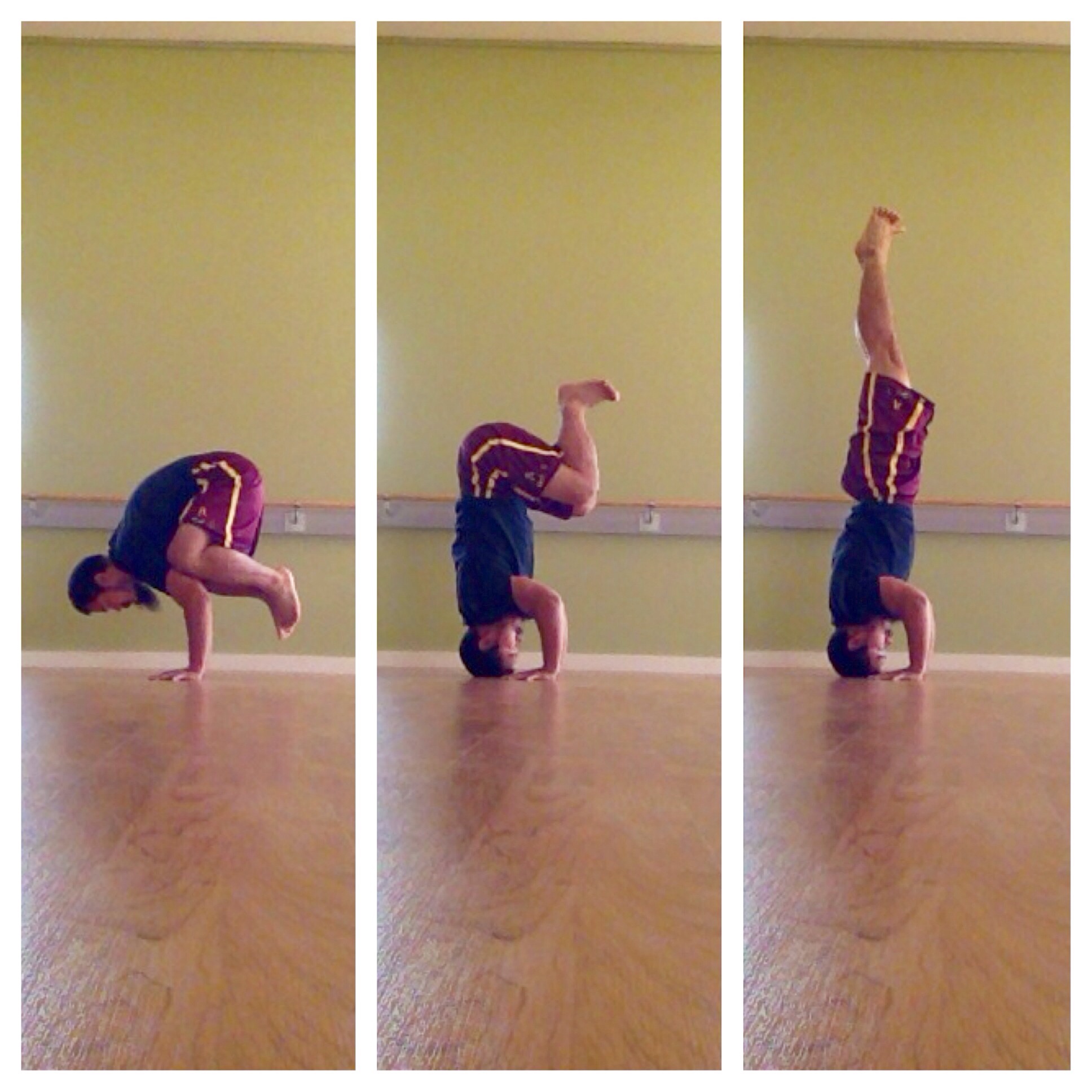
    This is not a knock on things like Sirsasana (Headstand) or lightly flowing through a Tai Chi set.

    The same attention to detail, the mindfulness and Presence, can be exercised in these ways too. It’s just that our achievement-oriented Minds often believe that progress is only measured by accomplishing a more difficult posture or learning the next sequence of forms.

    I am fond of suggesting that if you’re bored, then you’re boring.

    If you’ve run out of things to discover in Tadasana or the commencement form in Tai Chi, then you’ve probably actually stopped paying enough attention.

    I’m not sure if it’s Restlessness or Entitlement-Culture, but many of us, myself included, are so busy striving and believing that we are ready for The Next Big Thing that we miss the Beauty of more simple achievements.

  • TaiChi Is A Little Spooky

    It has been said that before Knowledge there was Truth.

    It would seem that some of the wisdom expounded in the Tao Te Ching might exemplify this notion.

    One of the peculiarities discovered by physicists only about a century ago, is the phenomenon known as Entanglement.

    The laws of Quantum Mechanics seem to suggest that particles can be linked in pairs (or groups) in such a way that the state of one inherently implies the opposite state in the other.

    Consider a pair of electrons.

    Upon measurement, an electron particle is found to have a clockwise spin. That measurement, the determination that Particle A has a clockwise spin, allows us to predict, correctly, that Particle B will have a counter-clockwise spin.

    It’s as if the particles are able to communicate, or interact, almost instantaneously, even across great distances. Albert Einstein himself, who was rather perturbed by the idea that particles could have this apparent ability to affect one another, described it as “Spooky Action at a Distance.”

    This phenomenon has sparked much discussion, debate, and experimentation that is still ongoing to this day. Modern Science is trying to make sense of what seems to be physical proof of a notion seemingly understood thousands of years ago.

    Out of the Void (Wuji), we arrive at polarity, or Taiji (TaiChi). Where there is Yin, we can be assured of Yang. To find one is to imply the other.

    Modern Science has allowed us to demonstrate, observe, and verify, down to the smallest scales imaginable, that this notion of TaiChi is in play.

    What the Ancients understood as being The Way, Science is grappling with Today.

    Our Knowledge is catching up to Truth!

  • Back to Basics

    The Thinker in me loves splitting all the hairs it can. The Details often reveal distinct characteristics and qualities of Things.

    In a sea of different styles of Yoga and TaiChi it is helpful to remember that all of these experiences have common ground.

    Literally thousands of variations on the numerous yogAsana and yet the Actions which create these postures and movements are all bound by the laws of Physics.

    Mechanically speaking, we make use of relatively few types of Action.

    There are so many ways to stand on one leg, but every single one of them requires us to stand on one leg.

    Acknowledging this coherence can help us simplify our Practice so that we don’t lose sight of what’s really going on.

    Even the most complex pose is merely a matter of mastering a few key Actions…
    and Practice!

    IMG_0838.JPG