Author: chibotaichi

  • Ch’uan

    The movement principles of TaiChi, and their expression in the field of Taijiquan (Tai Chi Ch’uan), are far less mysterious than they seem.

    For a variety of reasons, Truth can be hard to come by. The biggest impediment, however, is almost always our own refusal to see what is actually quite obvious.

    In many cases, a good Teacher will assist us in discovering how to see what we do not see intuitively. In some cases, a good Teacher must further obscure what we do not see intuitively. Yet, in both cases, the task of learning is ultimately up to the student.

    The curriculum of Taijiquan has been adapted and even watered-down as it has spread across the globe. As noted above, in some cases this alteration has been intentional and perhaps has been functional or even necessary.

    However, as the modified traditions are passed down and further modified with each iteration, the Truth and fullness of the curriculum becomes harder and harder to revive.

    While Taijiquan has been adapted to increase accessibility and has helped a massive amount of individuals with countless physical and mental health challenges, there is rarely more than procedural lip-service to the definitively Martial origins and underpinnings of the exercises.

    It is undeniably true that Taijiquan is a system of Qigong and has powerful health benefits. It is equally true that Taijiquan is a system of Martial Arts, and the movements and methods of Taijiquan have practical application in combative or self-defense scenarios.

    While the reality of this Martial connection is unnerving to some, the underlying principles which make Taijiquan effective for Martial purposes are equally applicable to most (indeed, possibly all) athletic Human endeavors.

    The generation, control, and transmission of Power might be the ultimate skill of Taijiquan, which is a useful ability in general. For baseball players, construction workers, and even a little old lady, the ability to mindfully use Power is worth cultivating.

    The skill needn’t be Martial in application, but there is no better platform for observing the movement principles of Taijiquan than in the context of Martial Arts. The “Ch’uan (Quan)” in TaichiCh’uan/Taijiquan means “fist” or “boxing” and to see Martial movements is to see the principles of TaiChi in action.

    Below you will observe blatantly Martial movements, but if you look beyond the merely Martial you will see the principles of Follow-Step (from Sun-style Taijiquan), Rooting, Zhan Zhuang Posture, etc.

    The principles are present, whether the action is obviously Martial or not. Learn to see the principles everywhere and you can begin to use them anywhere.

    The video-filter has conveniently generated vertical lines highlighing the deliberate vertical energy of Taijiquan. The Follow-Step principle is naturally and necessarily present throughout, both as a striking technique and as a space-management tactic, respectively.
  • The And/Or

    And/Or

    Wuji/Taiji

    Yin AND Yang: The WaveFunction-

    Both are present; in SuperPosition.

    Yin OR Yang: Measurement-

    Because the Quality perceived is measured by the Observer! It is only Yin when measured FROM Yang; It is only Yang when measured FROM Yin; Yin and Yang mutually set measure.

    You cannot fly, because you are measuring the Air from the perspective of Yang.

    If you measured from Yin, you would feel your skin capturing the breezes; easefully harnessing the Wind.

  • Modified Footwork in Section 2 of the Sun-Style 41 Forms Sequence

    Orient yourself to Relative-North and begin the sequence.

    The altered steps are as follows:

    • Play the Lute, with an angled Follow-Step.
    • Cross-Step, to cover 90 degrees.
    • Circle-Step, to cover 90 degrees.
    • Parry and Punch, with realigned Follow-Step.

    Any of the step can be altered to achieve different amounts of circling and destination. The sequence needn’t have prescribed Direction, it is simply a sequence.

    Honoring the sequence while disregarding the “normal” directions of the forms allows for more exploration of Rhythm and Space without needing to memorize new sequences.

  • The TaiChi of Suffering

    To not get what you want is Suffering.

    To get what you don’t want is Suffering.

    To get what you do want is also Suffering because everything is ultimately consumed by the churning of Time, and what we want to get, even if we do get it, is eventually lost.

    Yin and Yang make measure of each other.

    Yin and Yang follow one another.

    Any Thing, Experience, Phenomenon is neither Good nor Bad inherently except to the extent that you realize it is precisely as Good as it is Bad.

    It Is Both.

    It Is Neither.

    It Is.

    Tao.

  • Swing-Sequence

    As much as anything, Taijiquan is about the transfer of Power. To generate and deliver Power is a matter of proper sequencing. Developing precision and consistency of sequence is important in Taijiquan and also imperative to Golf.

    The sequence of Taijiquan movement is virtually identical to the sequence of a golf-swing.

    If you follow along with the video, you can see the process of Taijiquan at work: 1. Centered Posture (Wuji). 2. Empty-Step (Taiji). 3. Shift Weight (Hunyuan). 4. Turn Waist (Hunyuan). 5. Release Hands (Fajin). 6. Follow-Step (Taiji). 7. Stillness (Wuji).

    These stages can be articulated in various ways, and as is common with Motion, not all stages are best understood or expressed as static frames.

    Taijiquan, like a golf-swing and other phenomena, is fundamentally a description or utilization of a Process. When the sequence of any Process is clear, it can be more readily harnessed.

  • The Pursuit of TaiChi

    Although the ancient Taoist philosophy would in some sense advocate against it, the majority of the modern “West” loves a good chase.

    In the United States especially, there seems to be a deep-seated fascination with (maybe even a glorification of) clamoring and struggling in order to achieve something measurable and tangible.

    The classic Type-A character, busy plowing through task after task with so much purpose and drive, is the idealized archetype of a great Human Being. Productivity is the point of existence, and there needs to be proof of the work!

    When embarking on the journey of learning TaiChi, countless individuals have been subject to multiple confusions. First, and perhaps most absurd, is that the term “TaiChi” is typically being used as shorthand for “T’ai Chi Ch’uan”, which is a martial arts discipline and includes training of the Mind and Body through meditation and physical movement.

    The term “TaiChi“ (or T’ai Chi, for consistency’s sake) is more literally a reference to the paradoxical nature of Polarity or duality in the Universe. Some literal translations of TaiChi have been expressed as “Great Pole”, “Supreme Extremes”, and “Grand Duality”, all of which can be taken to mean “YinYang” (or if we wish to avoid the trappings of language, we can simply express TaiChi as ☯️).

    The martial art of T’ai Chi Ch’uan (also rendered as Tai Chi Chuan, or Taiji Quan) has its share of tangible achievements to be pursued. There is a valid sense of accomplishment when a sequence of postures and movements has been committed to memory. In many other systems of martial art, these kinds of achievements are marked by receiving a promotion of rank through the colored-belt system, and indeed to hold the rank of Black-Belt is no small feat.

    The trouble lies in the potential to get addicted to the achievements. If the whole game is about “the next belt”, then what happens when the final rank has been achieved? If the objective is to learn all of the sequences of posture and movement, what will happen once that objective has been met?

    Among other potential goals (like flexibility, focus, etc.), one of the most important quests in the study of Taiji Quan is an understanding of TaiChi itself; an understanding of the TaiChi Principle.

    The movements and postures of the Taiji Quan curriculum are all a study in Duality and Polarity. There can be no real mastery of Taiji Quan without some degree of understanding in regards to the YinYang interplay of the physical (and/or energetic) Body.

    While the tangible aspect of the discipline is very much concerned with movement, the subtle aspect is approached through stillness. Both movement and stillness are imperative. Neither can be fully meaningful without the other, and the relation between them is the very essence of TaiChi.

    The interplay of apparent-opposites is TaiChi. To fully understand TaiChi, it is imperative that both effort and ease be in play. Pursuing the practices known as TaiChi will be a good start, but if direct pursuit is the only mode of engaging with TaiChi, then true mastery and understanding will only elude and be hidden from the aspirant.

    The polarization, harmonization, and integration of Yin and Yang is TaiChi. The path to mastery of TaiChi requires not only active pursuit, but also the willingness to stop and be still so that TaiChi may pursue you.

  • Adjacent Location

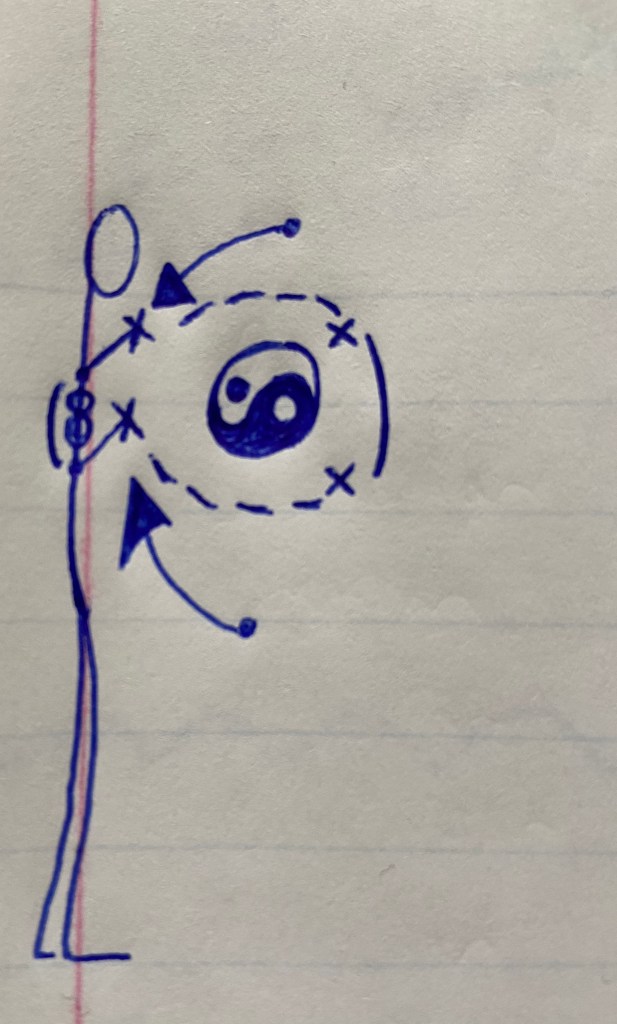
    As the arms move along the circular path, they essentially can arrive in four distinct locations:

    In-High

    In-Low

    Out-Low

    Out-High

    The only thing the arms will do is either stay put, or travel to an adjacent location.

    Like analog videotape, we can fast-forward or rewind, but we cannot skip frames or jump around. If the arm is at the In-High location, we know it will either travel to In-Low or Out-High, or else stay where it is.

    There is great simplicity to the arm movements this way.

    It’s similar to counting the sequence of numbers:

    1 2 3 4 5 6 7 8 9

    or

    9 8 7 6 5 4 3 2 1

    but never 1 2 8 …

    nor 9 8 5 …

    The arms simply honor the integrity of the sequence of the circle.

    There is no great mystery, just the clarity of sequence and movement from and to an adjacent location.