Category: Tai Chi

  • TaiChi Rhythm: What plus When

    Taiji movement, taken as a whole, is polyrhythmic.

    The rhythms are synchronized, but unique.

    At slow rates of practice this is made apparent, but at a moderate pace it becomes difficult to detect.

    This is why imitated TaiChi looks and feels clumsy.

    The Hands, Feet, Waist and other Body parts all tend to their specific tasks in their own rhythm similar to the dance of the planets in our Solar System.

    Each planet completes a rotation on its axis at a unique rate, creating immensely long days and nights on larger planets but quick periods of day and night on the smaller planets.

    Each planet revolves around the Sun on an individualized orbit, completing the journey without requiring the other planets to wait, nor asking other planets to catch up.

    Our Body can operate in a similar manner.

    When each part is free, or encouraged, to perform its function independently then the true Dance of TaiChi can play out.

    The relationship of specific unique rhythms and movements creates the overall Body-actions we think of as TaiChi.

    It’s not just What we are doing, but also When we are doing it!

  • That’s a Door. That’s a Wall.

    Out on The Way, there comes a point where you either turn left or right. It’s a fork in the road, as They say. If you turn left, you will encounter a wide-variety of distractions and oddities. There are countless details, funny little snags and plenty to chew on; Zigs and Zags galore.

    If you turn right, there is a much cleaner experience. Things are fairly straightforward. The path is well-maintained and very obvious. No frills or fanfare, just a path to follow.

    This is how it is.

    And it isn’t the case that you cannot switch. If you turned right and wish you hadn’t, you can struggle through the untamed brush and arrive on the other path. Likewise, if you turned left and are overwhelmed by it’s lack of clarity, you can trudge through to the other path (it’s easy to find, since it’s so predictable!).

    Ultimately, both paths work. They lead to the same destination.

    The funny part is, the destination is where you were before you ever came to the fork in the road. The Beginning is the End.

    And yet, once you’ve set out on The Way, you have to pick a path. Turn left, or turn right. It doesn’t matter which path you take, but you will have to walk it (or bounce back and forth between them) because that’s The Way. IT. IS.

    You can use the methods of thinking and analyzing to get there. You can use the methods of chaos and intuition to get there. It won’t make a difference in the end because getting there means arriving HERE.

    We’re out on The Way for a reason. Most of us are living out the fable of the Musk Deer.

    This poor ol’ Musk Deer roams the forest, searching for the source of the marvelous scent he has picked up on. Looking everywhere, he never seems to find it. Forever seeking, never finding, because the scent is coming from him. If he just stood still, he’d be all set.

    We are very much the same. We seek peace. We seek relaxation. We seek health and wellness, among so many other things. None of them are meaningfully outside of ourselves. That isn’t the Nature of Things.

    You cannot experience anything outside of yourself.

    You ARE an experience.

    It’s already happening.

    ALL THE TIME.

    The Mind and Body are doorways. TaiChi and Yoga are doorways. We are invited to walk through if we choose. Some doorways take us to the left, others to the right. All of them are useful, all of them are valid.

    But you have to go through. You have to keep walking.

    The need to understand the path is a wall.

    Attachment to the path is a wall.

    You have to keep walking.

    If you just sit down and refuse to keep walking, you will only delay your arrival.

    It does very little good to be mad that you are out and about. We have to get back.

    So you just keep walking the path.

    And when you finally realize you have re-arrived at the “destination”, you simply stay for as long as you can.

    All these paths and doors will lead you to that place. But you have to do the walking.

    And when you find yourself “There” (which is to say “Here”) you have to do the staying.

    And inevitably, by our own design or not, you will end up lurching off the mark again and have to take another walk.

    And each time this occurs, we run into the forks in the road; so we choose a path and we walk it until we get back again.

    There isn’t much else going on with this “Being Human”.

    Find your doors and go through. Acknowledge your path and keep walking.

    If you’re already There (again, read: HERE), then just stay put.

    Don’t put up a wall where you’ve been given a door.

  • World TaiChi and Qigong Day 2018

    IMG_5536

    It’s that time of year again! World TaiChi and Qigong Day will be observed on Saturday April 28, 2018. At 10:00 AM, in each timezone all around the world, TaiChi players and Qigong practitioners will contribute to a global wave of healing energy.

    Check out what events might be in your area, or just take a moment at 10:00 to share some deep breaths with the whole world. One World, One Breath.

  • Flip It If You Gotta

    The Law of TaiJi tells us that there is always something to be uncovered if we believe we have arrived at a conclusion.

    When we dream up our ideal life, we rarely consider what suffering is included.

    We talk about the qualities we want in a partner, but rarely acknowledge what kind of quirks we can reasonably tolerate.

    We play the (unduly simplistic) Opposites-Game.

    I want this quality which I like.

    I don’t want this quality that I do not like.

    Which qualities that you don’t like do you want? Which qualities that you want are you happy to do without?

    See how this works?

    I’ve been thinking about the Practice of keeping a Grattitude Journal after listening to a Sharon Salzberg lecture, but I know from experience that I don’t fare well with the conventional approach to this Practice.

    List three things, each day, that you are grateful for. Easy enough, but it quickly becomes a merely cerebral exercise and feels like a chore. It feels like the kind of forced and potentially-fake positivity that is so pervasive in the SocialMedia landscape.

    So I poked around my mind for awhile, and it became clear that I could also ask myself, what are three things I’ve taken for granted today?

    What we take for granted is where our grattitude truly lies, and it seems to me that the beauty of it all actually depends upon our taking it for granted.

    That’s how Grace works.

    It’s not that we must never mention or recognize it. In fact, when we do it will be all the more genuine. It’s like getting lost in Presence and then realizing what’s happening. Rather than searching for it, it simply arises.

    You can be grateful for all the little, and the big, joys and surprises during the course of a given day, but for my Mind it is much more powerful to pause and recognize all the things I am able to not even notice and to appreciate that this not-noticing is even possible.

    Afterall, the Good and Bad aren’t so obvious in the long run and with enough Looking you can see how to flip them into each other anyhow!

  • S**T.

    Surely everybody knows the phenomenon: you go to the bathroom and the result doesn’t match the expectation. You might think you’re going to evict days worth of food and get rabbit pellets. You might plop down expecting nothing to happen at all and require the courtesy flush! That’s life, eh?

    Practice sometimes feels the same way.

    Oftentimes when it seems like our efforts won’t be fruitful is when we get the wildest results, or have the most incredible experiences.

    If ever there were a meaningful case for DailyPractice, surely this is it.

    There are no guarantees that we will have epiphanies or transcendent highs, but if we don’t attend to Practice we are assured to not have such moments.

    The Gretzky-classic goes, “You miss one-hundred percent of the shots you don’t take.”

    Even when it seems irrelevant or unimportant, Practice.

    There aren’t substitutes or shortcuts. You just do the work.

    Sometimes it will feel wonderful and amazing.

    Sometimes it will feel procedural or difficult.

    But Practice is not about how it feels in that moment. It’s about tending to the moment, no doubt, but Practice is largely just for Practice’s sake. You do it because you can.

    Because you want to.

    Because you have to.

    Because what you develop through Practice pays off when it’s time for “performance”, so to speak.

    You don’t have to like Practice to get results. But you will have to do it.

    Shit.

  • A Tai Chi Glossary

    Wu Ji (Wu Chi): Without Ridgepole/No Polarity/Boundless
    Tai Ji (T’ai Chi): Great Ridgepole/Grand Polarity/Yin-Yang
    Yin: Feminine Principle, Cold, Dark, Earth
    Yang: Masculine Principle, Hot, Light, Sky
    Qi (Ch’i, Chee, Chi): Energy/Breath/Force
    Qigong (Chee Kung, Ch’i Kung): Energy Cultivation
    Taijiquan (T’ai Chi Ch’uan): Grand Polarity Fist
    5 Major Styles of Taijiquan: Chen/Yang/Wu/Hao/Sun
    Dan Tien: Energy Center/Elixir Field
    Meridian: Pathway for Qi/Acupuncture Lines
    Yi: Intent/Focus
    Song: Relax/Open
    Peng: Open/Expand/Full
    Zhan Zhuang: Post Standing
    Tui Shou/San Shou: Push Hands/Sparring

    This non-definitive list of important TaiChi concepts and translations can help us recognize and understand the route a simple philosophy travels to become useful in different circumstances. The TaiJi Principle shows up, naturally, according to the manner which we choose to make use of it. The same dynamic of Yin and Yang allows us to cause great damage, as well as great healing. TaiChi is useful in both Martial Arts and Medicine.

    Once we have understood Qi, our Practice is super-charged, regardless of where we seek to apply the knowledge and skills. The fast-track to cultivating and experiencing Qi is Stillness. Indeed, from the TaiChi principle it can be realized that the Movements lack meaning unless there is mastery of Stillness.

    Every time we allow Wuji, we are arriving at The Well of Taiji wisdom. Anything that happens after Wuji is normal. It is all Taiji out there in the World. TaiChi is the very mundane matrix we experience day after day. Liberation from that is only possible by side-stepping into Wuji. Anything else is merely being caught in the tides. To know the nature of The Flow and to be caught up in It are different affairs.

    Pay Attention. Stillness has the answers.

    Return to The Well again and again. Each time it will offer something novel, but each time it will seek to remind you of what you already know. Return to The Well. Return to Wuji. Return to the state of remembering.

  • The Forms are a Vehicle

    In Tai Chi, as well as in Yoga, the outwardly-visible is never the whole story.

    The movements of Tai Chi forms are not routines to be learned for the sake of accomplishment and performance, but rather to train energetic and mechanical alignment and efficiency, as well as to cultivate a quiet mental focus or intention.

    The same underlying premises and directives exist in all Tai Chi postures and movements. What is to be done in one particular movement is also the imperative in all the others.

    To borrow the great Yogic maxim: Sub Ek. All One.

    The reason a skillful Tai Chi player appears calm and relaxed is because there is nothing exciting or compelling in their experience of executing the forms. The quiet moment before commencement is present throughout the entire sequence.

    An external-only approach to playing the Tai Chi sequences is like walking around a tranquil and still lake. The internal approach means to become the lake.

    Whether you count 8, 24, 48, 73, 97, or 108 forms in your Tai Chi sequence of choice is not relevant once we are practicing the internal aspects.

    There is only YinYang, the Tai Chi, and as we allow Yin and Yang to flow we hold to the Wu Chi in the center. We carry and become the stillness around which movement occurs. We become the lake, rather than merely walking around it.

  • Zhan Zhuang

    zhanzhuan

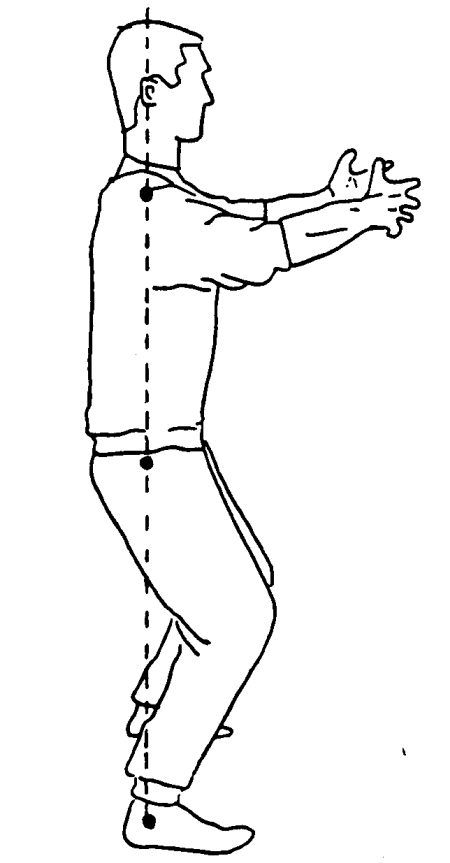
    This illustration shows the vertical nature of the body in Zhan Zhuang practice.

    Other variations of the posture will have more or less bend at the knees, but the overall alignment is the same.

    Without adding effort or tension to the body, the vertical alignment is created and maintained so that the posture becomes efficient and comfortable.

    -Comfortably-spaced feet (Parallel)

    -Knees bent and relaxed

    -Hips free, to allow articulation of the Pelvis

    -Tailbone tucked and/or aligned with the thighs (keep the Pelvis level)

    -Lower Belly relaxed and expanded (keep the Pelvis level)

    -Spine straight (NOT the natural curve of the Spine)

    -Shoulders neutral (allow the Arms to lower the Shoulders)

    -Chest relaxed (as if resting against the Spine)

    -Crown lifted, Chin released (lengthen and straighten the back of the neck)

    -Tongue-Tip toward the roof of the Mouth 

    -Eyes relaxed or closed

    Remember that the goal is to have Gravity be the source of the Standing. Allow the Body to be heavy down below and light up top.

    The TaiChi principle is YinYang. By going Down, we are able to be Up!

  • More Circle GIFs

    Hopefully this ludicrously-lame GIF makes more clear the action of the Arms in our TaiJi Circles…

    arm-paths

    The Arm action has been reduced to it’s most basic form:

    “In with the Elbow…Out with the Hand”

    The two components not as clearly articulated here are the “Turn the Waist”-phase of the Circles, as well as the “Recovery”-phase.

    This serves as a good reminder that once the arms have completed their task, they no longer need to DO anything (except for Listening or holding space, as the case may be), and the rest of the Body continues to direct and/or utilize the Energy.

  • 24 Forms at The Arb

    One of my favorite places is the University of Minnesota Landscape Arboretum.

    There are numerous gardens, as well as natural habitat to explore, among other sights.

    You can observe a number of quirks with this performance of the forms, most notably some variations with the footwork in the last few forms.